
Review of Hertfordshire council constitution launched after controversial meeting
Proposals to review parts of Hertfordshire County Council’s constitution are to be drawn up after a controversial meeting where Conservative councillors walked out.
In November, a specially convened meeting of the council considered options for reorganisation of local government in Hertfordshire that would replace the existing upper-tier structure of the county council and the 10 district and borough councils with two, three or four unitary authorities.
In an “indicative” vote at the end of that debate, councillors were asked to express a preference by voting ‘for’ one of the three options or to abstain.
Without the option to vote ‘against’, Conservative members left the chamber. On Monday, the council’s overview and scrutiny committee met to consider the “controversies” of the November meeting. Members agreed to ask the council’s standards committee to review the council’s constitution relating to council meetings in the new year.
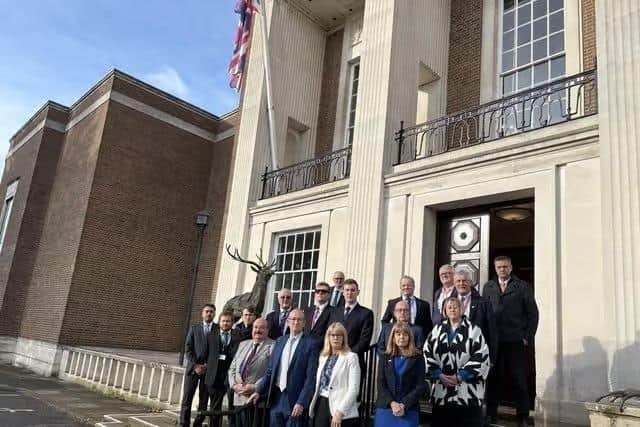

They also recommended that to avoid confusion, leaders of all the political groups meet in advance of each meeting of the full council.
That has been welcomed by the leader of the council’s Conservative group, Cllr Richard Roberts, who told the Local Democracy Reporting Service: “I think it is a very necessary outcome.
“I think the scrutiny meeting enabled a better understanding of the challenges of a new five-party system and dealing with issues like extraordinary meetings.
“And it brought into sharp relief the need for us to look at the constitution… making sure that issues that may arise, that could compromise meetings, are understood.”
The extraordinary meeting of the overview and scrutiny committee was secured by Cllr Alexander Curtis (Con, Hoddesdon North), backed by Cllr Caroline Clapper (Reform UK, Watling) and Cllr Christopher Alley (Con, South Oxhey and Eastbury).
At the meeting, Cllr Curtis said that without the option to vote ‘no’ on LGR, councillors had been “silenced, gagged and deprived of their natural rights to oppose”.
He said that there should always be an option to vote ‘no’ at council meetings, whether votes are indicative or otherwise.
“‘No’ is one of my favourite words in the English language,” he told the meeting. “It is a safeguard. You can use it to reject something that has not been fully thought through, that is sub-optimal.
“You should always be able to vote ‘no’ as an elected representative. And the fact that we weren’t able to do so I feel is wrong.
“And even if it is permitted legally under our constitution to have that, I don’t think that that should be the case. I think that any motion that is brought, it shouldn’t be inevitable that it passes.”
Director of law and governance Quentin Baker stressed to councillors that the meeting in question had been “a highly unusual” one.
The business of the meeting had been to indicate a preference for one of the three unitary authority models in an “indicative” vote, with the actual decision to be taken by a meeting of the Liberal Democrat cabinet.
Mr Baker said that with the need to choose between three options – rather than the usual binary voting options of ‘for’ and ‘against’ – they had had to create a hybrid process.
This approach was circulated widely in advance of the meeting and no objections were received. Advice suggested that inclusion of a ‘none of the above’ option would not have been appropriate.
He told councillors there had been no legal requirement for the council to hold a vote on local government reorganisation (LGR) at all; some of Hertfordshire’s 11 councils opted not to do so. On the day of the debate in November, some concerns were raised about the inability to object to LGR and to an amendment submitted by the Conservative group.
At that point, Mr Baker said, he had advised that members could make statements “in parallel” to their vote which would be recorded in the minutes.
The leader of the county council, Cllr Steve Jarvis (Lib Dem, Royston West and Rural), focused on the indicative nature of the vote, suggesting that it may have appeared that the council was taking a decision when in fact it was not.
He said councillors should have been aware of the process in advance of the meeting and had ample opportunity to raise points prior to it.
But he backed a review of the constitution, saying it was “not inappropriate at this time for there to be a review – and ensure the constitution is meeting the needs of the council”.
Scrutiny committee vice chair Cllr Steven Watson (Green, Ware South) was among those who questioned whether there had been a need for a formal vote at all. He said that “an awful lot of politics had been played” and added: “On reflection, I think the politics got in the way of a good debate by having that voting.”