
Borehamwood students advance to finals in prestigious international maths competition
“I am so proud to see how well the group has done in entering the competition"
For 14 straight hours in early March, a small group of Haberdashers’ Aske’s Boys’ School students came together to participate in an international online maths competition. A combination of maths smarts and creative thinking has added up to a spot in the finals for the team, whose submission was selected as one of the best solutions to assess both financial risk and the broader societal impacts of online sports betting.
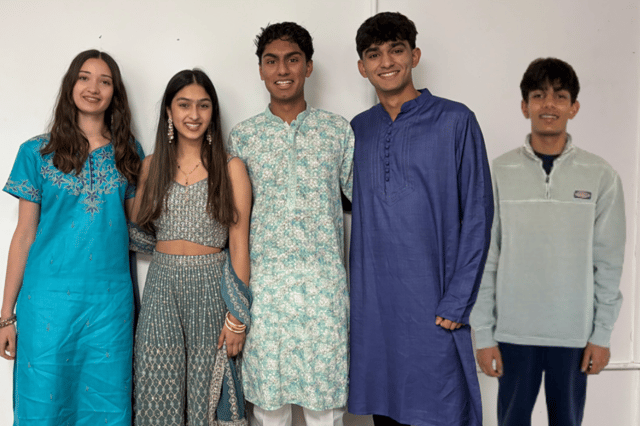

The students – Sofia Rusche, Anika Gupte, Aarav Rajput, Arav Mathur, and Aarav Shah of Borehamwood-based Haberdashers’ Aske’s Boys’ School – make up one of the nine finalist teams in MathWorks Math Modeling Challenge (M3 Challenge), a unique competition that drew more than 3,430 11th and 12th graders in the U.S. and sixth form students in the U.K. this year. The team, whose work underwent intense scrutiny by judges in the first two rounds of assessment, has one last hurdle when they head to New York City on April 27 to present their findings to a panel of professional mathematicians for final validation.
Using mathematical modeling, students had to come up with solutions to real-world questions such as: Should we be concerned as a society about the growth in online sports gambling? How much total money is being lost to sports gambling in the U.S. and U.K. yearly? How much is too much for an individual to spend on online sports gambling?
Now in its 21st year, M3 Challenge is a program of Philadelphia-based Society for Industrial and Applied Mathematics (SIAM) and is sponsored by MathWorks. It spotlights applied mathematics as a powerful problem-solving tool and motivates students to consider further education and careers in applied math, computational and data sciences, and technical computing. Winning teams will be awarded a share of ~£75,000 in scholarships, with the champion team receiving ~£16,000.
Out of the total 770 teams, just over 70% hailed from the United States, with 40 states represented. The other participating teams represented schools in the United Kingdom. Approximately 32% of team submissions self-indicated they used MATLAB technical computing software to support and enhance their solutions. The code included in these papers underwent a separate judging process for the MATLAB Technical Computing Awards, which are additional scholarship prizes for outstanding use of MATLAB.
“More and more, conversations around sports are filled with spreads, lines, and suggested parleys,” said Dr. Neil R. Nicholson, professor of the practice at the University of Notre Dame, and M3 Problem Development Committee member. “That got us thinking about gambling in all its aspects, and we eventually settled on app-based sports gambling for this year’s problem topic.”
“Our aim wasn’t to define the practice as good or bad, but to understand what role it has in today’s society,” Dr. Nicholson explained. “With so much discussion among younger generations focused on affordability and income, we looked at the intersection of disposable income and sports gambling and how that relationship differs across demographic groups. In the third part of the Challenge problem, we also asked teams to make their math ‘make sense’ to the general public to emphasize that mathematical modeling isn’t just about the models and analysis, but also about data literacy and communicating results in a way that is clear to broader audiences.”
The team’s coach, mathematics teacher Kim Harrison, spoke proudly of the students' performance. “I am so proud to see how well the group has done in entering the competition. They worked tirelessly to upskill in their MATLAB skills, and alongside their strong mathematical abilities and team working skills, have been able to successfully complete the mathematical modelling task. Alongside this they have developed their communication and project-based skills, it has been an enriching experience for them.”
Team member Aarav Rajput said that M3 Challenge was worth the student's time. “Spending 14 hours on a single maths problem from early on a Sunday morning isn’t easy, but that’s exactly what made this experience so valuable.” Rajput continued, “M3 Challenge pushed us to think deeply, collaborate under pressure, and trust each other’s ideas and innovation. There’s nothing quite like the moment when a solution finally clicks just before the deadline and makes all the effort worthwhile. More than anything, we came away stronger as a team and more confident in tackling real-world problems.”
In addition to Haberdashers’ Aske’s Boys’ School, the other finalist teams hail from schools in Edison, New Jersey; Chandler, Arizona; North Ridgeville, OH; Delray Beach, Florida; Alexandria, Virginia; Frisco, Texas; New York City, New York in the U.S. and Colchester, Essex in the U.K.
For more information about M3 Challenge, visit https://m3challenge.siam.org/the-challenge/.
To view this year’s challenge problem, visit https://m3challenge.siam.org/m3-challenge-2026-problem/.
To see the full list of finalist, semi-finalist, and honorable mention teams, visit https://m3challenge.siam.org/2026-winning-teams-list.