
Hertfordshire police chief defends facial recognition technology after racial profiling concerns
Hertfordshire Police will work with its race inclusion board to ensure fairness as it trials the use of live facial recognition (LFR) technology for the first time.
Chief Constable Andy Prophet sat down with the force’s Police and Crime Commissioner (PCC) Jonathan Ash-Edwards for their accountability and performance meeting on Thursday.
The meeting allows the PCC to ask questions of the chief constable and to hold him to account. The PCC began the meeting by asking the chief constable about the launch of live facial recognition technology this month and to address some of the concerns residents may have.
Chief Con Prophet said: “There’s a huge amount of safeguarding behind it. What’s important here is, I recognise, and the evidence base nationally indicates that some members of our community may feel worried about this, from an infringement on civil liberties.
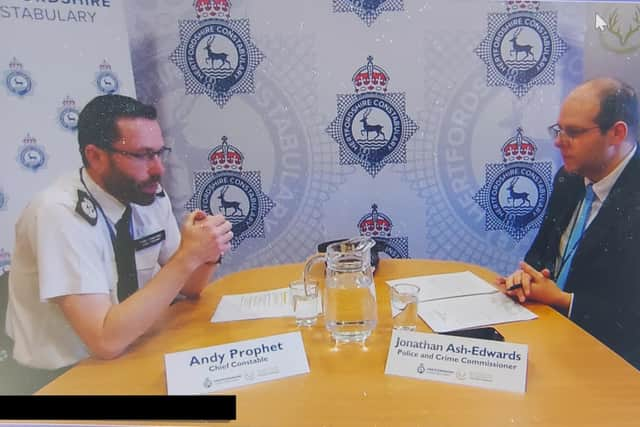

“Some particular parts of our community may feel that they could be disproportionately targeted by this. What I can say to you is that the evidence base nationally says that there’s no statistically significant difference between the accuracy of the technology for any kind of demographic factor.
“There are differences, but no statistically significant difference. So we will be working really hard with community groups in Hertfordshire… with the race inclusion board and others, to say, ‘This is it, this is how it works, come along and see how we’re trialling it to build that trust and confidence.'”
Live facial recognition compares a human face captured by a camera against digital images uploaded to a secure database called the Watchlist. This process is fast, accurate, and designed to help identify individuals wanted for serious offences.
According to Hertfordshire Constabulary, the Watchlist is manually populated for each deployment and includes individuals wanted by police or courts for serious offences such as violent or sexual crimes and those subject to court orders, including registered sex offenders.
Asked how the technology works, the chief constable said: “It captures the faces of people walking past it, and the technology matches the individual. So if I’m Billy the burglar and I walk past that camera… it will say that person there looks like Billy the burglar, you then look at it and go, ‘That is a good match, I agree with the technology’ and you as an expert then would go and send a local officer in that high street or zone and say, ‘Go and stop that person, and have a conversation with them because the technology suggests that’s the burglar.’
“If the officer goes and confirms it is, the arrest gets made. If it’s not, the system is really, really accurate, so in the small chance it’s not, we can correct that, and the person can go on their way. It’s neighbourhood policing, supported by technology, to try and put our neighbourhood officers in front of the right people. A key part of this is making sure it’s done in a professional and human way. This is not brand new technology; it’s been used successfully in other forces in the country, in London, in Essex, and elsewhere, and it’s having some really good results.”
Asked about how deployment places are selected, the chief constable said: “There’s not really an obvious answer, to be frank. We will pick the places where people are likely to be, and or where our crime is likely to be high. So, high streets, high footfall areas are the types of places where we would deploy the technology.
“It’s a mobile capability that we can develop, so you can put the cameras in a van, for example, and put it in the right place. So we can be really, really thoughtful about how we do it.”
Asked about the technology’s accuracy, he said: “There are some statistics I could talk about here, but the headlines are that it’s really, really good at positively identifying people. And there are really very low circumstances when it identifies someone incorrectly.
“The safeguards that are in place around that are – that’s the technology – and there are people who make further decisions on the back of that. So, the person in the van says, ‘I think that is a good match by the tech’, then sends an officer…so there is always a human interaction…An officer will have a conversation with the person and check the facts that the technology is giving them. Only if they agree with it will they use their powers to make an arrest.”
Asked what happens to images of members of the public caught on camera who were not matched to wanted suspects, the chief constable said: “That image is immediately deleted. The image is processed, the system says, ‘That person isn’t on our record list’, and the machine immediately forgets it.
“If the individual is a match, that image will be retained for 24 hours to ensure there’s an audit trail for the action that was taken on the back of that. If it’s not you, your image is immediately deleted.”