
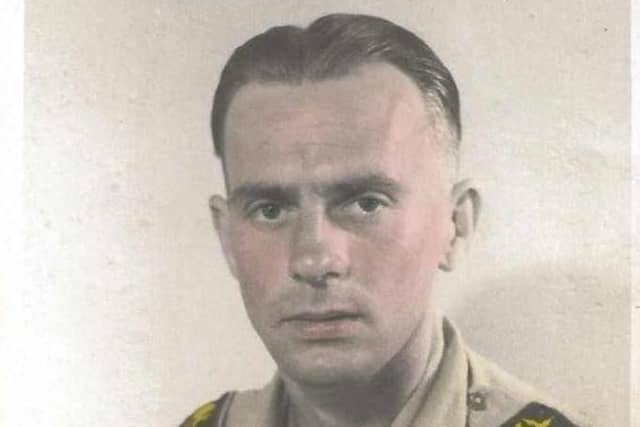

Leonard Charles Collins was born on the March 3, 1919 at 20 Henry Street, Tring. He was the youngest of Walter & Alice Collins eight children.
Leonard was a pupil at both Gravelly and Tring High Street Schools. By 1936 he was employed at John Dickinson, Paper Mill in Apsley. At the time young employees were encouraged to join the Territorial Army from which you would receive a one off payment of £5 plus one week off each year to attend training.
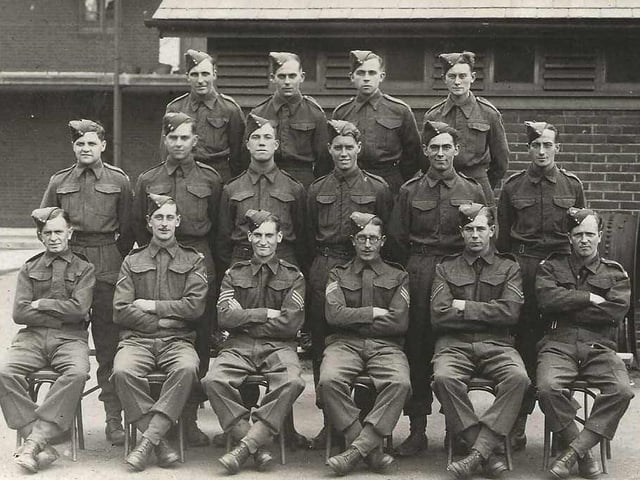
It was because of this that when WW11 broke out Leonard enlisted to the 1st Battalion Middlesex Regiment at Inglis, Mill Hill barracks in London, NW7. At just 20 years of age Leonard’s regiment was part of the British Expeditionary Force in France experiencing intense action from the rapid German advance.
Leonard soon found himself promoted to Lance Corporal & Machine Gunner of “C” Company when on the 15th May 1940, “C” company, engaged with the enemy and destroyed two heavy German machine gun units enabling the infantry to regroup.
However as we know the Expeditionary Force were overwhelmed by the German advance and were forced to retreat to the Dunkirk beaches and await embarkation to England. Leonard made it back to England on the June 13, 1940 arriving, “bare footed” at Tring station. This was apparently not uncommon when one considers the soldiers having to wade out to the rescuing boats.
He immediately returned to his regiment in Kent where they remained until 1942 on full alert preparing for the expected German invasion.
Whilst off duty the soldiers would frequent the local dance at the “The Welcome Stranger” pub in Lympne. It was there that Leonard met Leading Aircraftwoman, Woman’s Auxiliary Air Force, Renée Hornby-Burgess, who was on leave from Tangmere Airdrome while visiting her parents. (Renée’s father had served in France during WWI. He liked the name, Renée because it translates to ‘Born Again’).
They married on June 27, 1942 at St Peter and St Paul’s Church in Tring. This was understood to be the first full military wedding at the Parish Church since the outbreak of war. After the wedding, Leonard returned to duty where he was then on continuous active service throughout the rest of the war travelling through, North Africa, Sicily, Egypt, Italy and finally Austria.
On returning to Tring, after being discharged in 1946, he and Renée moved into 26 Henry Street. Many of the properties on Henry Street were owned by the Co-Op Society. They were reasonably maintained having two ground floor rooms and two first floor bedrooms. However, the facilities comprised of an outside shared WC and washhouse serving two or more families with a metal bath hanging on the outside wall. The kitchen had a coal/wood burning stove and a single cold water tap.
He returned to work at his pre-war employer, John Dickinson who held his position open for him as they did for all their serving employees. In January 1959 Leonard was offered a job in the Transport office of Tunnel Cement in Pitstone where he remained until he died quite suddenly from a heart attack in December 1968. This was only one week after attending the annual Middlesex Regiment Reunion in Kensington, London. He was just 49 years old.
Leonard’s funeral took place with full military honours at Tring’s, St Peter & St Paul’s Church the following January 1969.
His son Richard Collins has kindly provided us with his story, these images and we will soon have the pleasure of exhibiting Leonard’s medals at the museum.
5. Contributed
With his fellow servicemen Middlesex Regiment Barracks, Mill Hill 1939 Photo: Submitted